
Most eCommerce brands treat email automation like a “set it and forget it” afterthought.
They’ll throw together a basic welcome series, maybe add an abandoned cart flow if they’re feeling ambitious, and call it a day.
Meanwhile, their competitor down the street is running a full automated email engine that generates 30% – 40% of their revenue on autopilot.
The difference? Six flows instead of two.
Here’s the thing: email flows aren’t just “nice to have.” They’re the foundation of a profitable email program. They work 24/7, nurturing customers through every stage of their journey—without you lifting a finger.
And if you’re missing even one of these six flows, you’re leaving serious money on the table.
Why Most Brands Get Email Flows Wrong
I see the same mistakes over and over:
➜ They build flows once and never touch them again. Markets change. Products change. Customer behavior changes. Your flows need to evolve too.
➜ They skip conditional splits. So someone who just bought keeps getting emails telling them to buy. Terrible experience. Wasted sends.
➜ They treat all customers the same. A first-time buyer needs different messaging than a repeat customer. Your flows should reflect that.
The result? Flows that underperform, customers who unsubscribe, and revenue left on the table.
Let me show you what a complete automated email system actually looks like—and how to build it the right way.
The 6 Non-Negotiable Flows
These are the flows every eCommerce store needs. Period. If you’re missing even one, you’re not maximizing your email revenue.
Welcome Flow
Purpose: Turn new subscribers into buyers—or at minimum, educate them so they’re primed to buy later.
Your welcome flow is your first impression. Someone just gave you their email. They’re engaged. They’re paying attention. What you do in the next 7-14 days determines whether they become a customer or just another inactive subscriber.
What it includes:
➜ Immediate delivery of your welcome discount
➜ Brand story and founder intro (people buy from people)
➜ Product highlights with clear differentiation
➜ Social proof (testimonials, reviews, media mentions)
➜ Risk reversal (guarantees, free returns, hassle-free refunds)
➜ Competitor comparison (“us vs. them”)
➜ Urgency emails as discount expiration approaches
➜ Personal note from founder extending the offer
Structure: 8 emails over 14-16 days with 1-2 day delays between each.
The Discount Debate
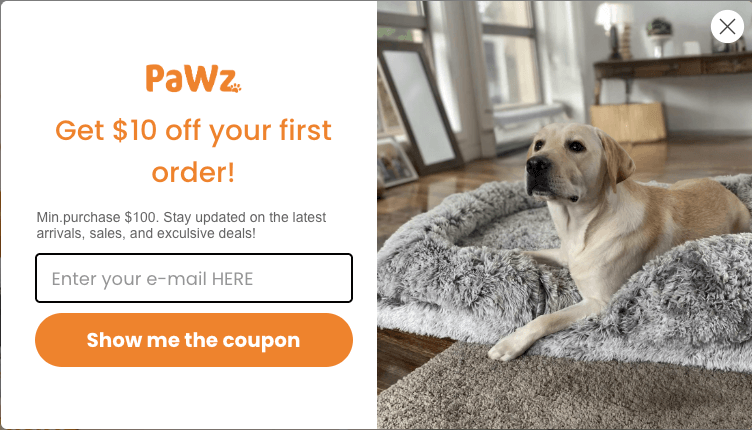
Should you offer a welcome discount? Absolutely. You’ll make it back through customer lifetime value. Every top-growing eCommerce brand does this. Follow what works.
Pro tip: Give a bigger discount for mobile opt-ins. Check out these two pop ups from Pawz 👇

Here’s what most brands miss: after every email, you need a conditional split.
If someone purchases after Email 2, they should immediately exit the Welcome Flow and enter your Post-Purchase Flow. Without this, they’ll keep getting Emails 3-8 promoting a discount they already used. That’s a terrible experience.
Set up your splits like this:
➜ YES path (exit flow): Person has placed order at least once since starting this flow
➜ NO path (continue): Proceed to next email
Abandoned Cart Flow
Purpose: Recover revenue from people who added items to cart but didn’t check out.
This is the most obvious flow, but most brands still mess it up. They send one generic “you left something behind” email and wonder why recovery rates are low.
What high-performing cart flows do differently:
➜ Send 3 emails, not 1 (Email 1 at 1 hour, Email 2 at 6-12 hours, Email 3 at 24 hours)
➜ Show the actual products they abandoned with images
➜ Add social proof specific to those products (reviews, bestseller badges)
➜ Include a small incentive in Email 3 (5-10% off) to push fence-sitters
➜ Address common objections (shipping costs, return policy, sizing concerns)
Abandoned Checkout Flow
Purpose: Recover people who entered checkout but didn’t complete purchase.
This is different from cart abandonment. These people were this close to buying. They entered their shipping info. Maybe even their payment details. Something stopped them at the last second.
Common checkout abandonment reasons:
➜ Unexpected shipping costs
➜ Long delivery times
➜ Concerns about security or legitimacy
➜ Just needed to “think about it” (a.k.a. decision paralysis)
What this flow does:
➜ Sends 2 emails (1 hour and 6-12 hours after abandonment)
➜ Directly addresses objections (free shipping threshold, fast delivery, trust badges)
➜ Includes strong urgency (“Cart expires in 24 hours”)
➜ Offers customer support (“Questions? Hit reply or call us”)
Browse Abandonment Flow
Purpose: Re-engage people who viewed products but never added to cart.
These are warm leads. They’re browsing. They’re interested. They’re just not ready to commit yet.
What this flow does:
➜ Sends 2 emails showcasing the products they viewed
➜ Adds social proof specific to those products
➜ Includes “customers also loved” recommendations
➜ Creates gentle urgency (“Low stock” or “Selling fast”)
This flow is lower priority than cart/checkout abandonment, but it’s still valuable for capturing people early in the consideration stage.
Post-Purchase Flow
Purpose: Turn one-time buyers into repeat customers.
This is where most brands completely drop the ball. They get the sale and then… crickets. Maybe a basic “thanks for your order” email and that’s it.
Meanwhile, the cost to retain an existing customer is 5-7x cheaper than acquiring a new one. And repeat customers spend 3x more than first-time buyers.
What this flow includes:
➜ Order confirmation (immediate)
➜ Shipping notification
➜ Delivery confirmation
➜ Product usage tips (3-5 days after delivery)
➜ Review request (7-10 days after delivery)
➜ Cross-sell/upsell (14-21 days after delivery)
The cross-sell email is critical. Recommend complementary products based on what they bought. Someone who purchased a yoga mat? Suggest blocks, straps, or a mat cleaner. Don’t just throw random products at them.
Pro tip:
Segment your post-purchase flow by product category. Someone who bought a dog toy needs different follow-up than someone who bought dog food. Personalization = higher conversions.
Win-Back Flow
Purpose: Re-engage customers who haven’t purchased in 90-180 days.
Even your best customers will go quiet eventually. Life gets busy. They try a competitor. They forget about you. This flow brings them back.
What this flow does:
➜ Sends 3 emails over 2 weeks
➜ Email 1: “We miss you” + showcase new arrivals
➜ Email 2: Exclusive discount (15-20% off)
➜ Email 3: “Last chance” urgency + stronger discount (20-25% off)
When to trigger this flow:
➜ For consumables/repeat-purchase products: 2x the average replenishment cycle
➜ For non-consumables: 120-180 days since last purchase
➜ For VIP customers: 90 days (you don’t want to lose your best buyers)
The One Thing That Breaks Every Flow (And How to Fix It)
Here’s the biggest mistake I see: no exit conditions.
Brands build flows in isolation without considering how they interact. The result? Customers receive contradictory, overlapping messages that destroy the experience.
Example: Someone buys a product, enters your Post-Purchase Flow, then 3 days later gets an email from your Win-Back Flow because they were tagged as “inactive” 120 days ago. Confusing, right?
The fix: Set up flow-level filters and conditional splits.
Every flow should have clear entry and exit rules:
➜ Welcome Flow: Only people who’ve never purchased. Exit immediately upon first purchase.
➜ Cart/Checkout Flows: Only people who haven’t completed that specific order. Exit if they purchase.
➜ Post-Purchase Flow: Only people who just completed an order. Exit if they purchase again (re-enter new post-purchase sequence).
➜ Win-Back Flow: Only people who haven’t purchased in X days and aren’t in any other active flow.
What Happens After You Build These Flows?
Once these six flows are live and optimized, they run on autopilot. You’re not manually sending emails. You’re not wondering what to write next. The system handles it.
And here’s what that looks like in practice:
- 20-30% of your total email revenue comes from flows (vs. 70-80% from campaigns)
- Your email program works 24/7, converting customers while you sleep
- Your campaigns perform better because flows nurture subscribers into engaged buyers
- Customer lifetime value increases because you’re retaining and re-engaging at every stage
But here’s the reality: building these flows takes time. Testing takes time. Optimization takes time.
Most eCommerce founders don’t have that time—they’re too busy running the business.
That’s exactly why I built Copy Overdrive.
Want these flows built for you?
I set up all 6 of these flows for my eCommerce clients in the first 30 days. Complete setup, professional copy, brand-aligned design, and ongoing optimization. You approve emails, I handle everything else.